Key Takeaways from “UCU During War and Beyond”
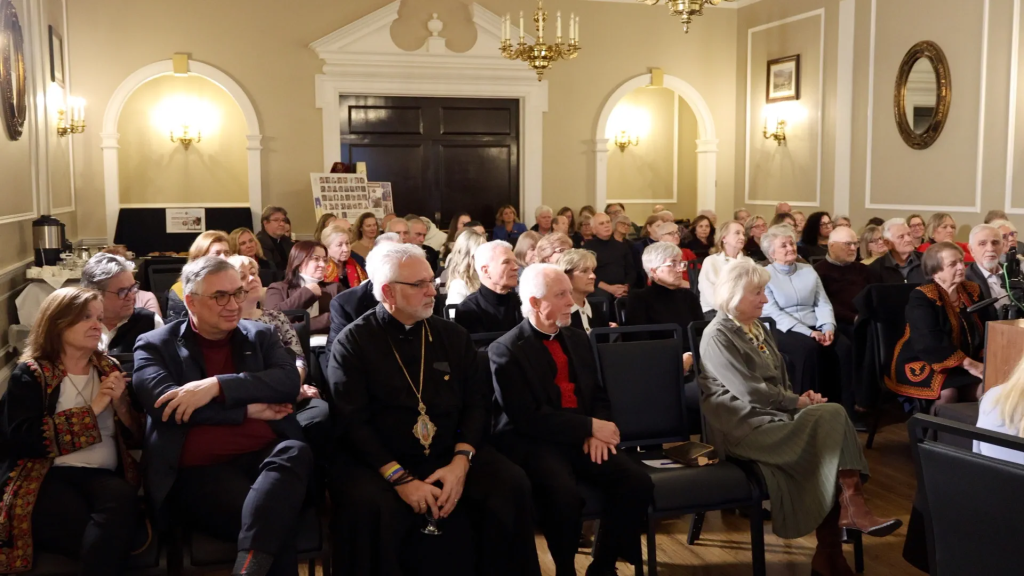
On November 20, a meeting titled “Ukrainian Catholic University: During War and Beyond” took place in Toronto. It was organized by the Ukrainian Catholic Education Foundation (UCEF) and the Toronto Friends of UCU. The event brought together people who have supported the University for many years, as well as those interested in how Ukrainian educational institutions operate during the war and the role they can play in the country’s recovery.
The evening focused on presentations by UCU Vice-Rector for Strategic Development Sophia Opatska and Executive Director of the Center for Leadership of UCU Andrew Rozhdestvensky. Both spoke about different aspects of the University’s work, yet their messages converged on one point: today, the effectiveness of institutions is determined not by circumstances, but by the principles they stand on – and by the people who embody those principles.
A University That Serves: On UCU’s Transformation During Wartime
The formal gathering began with welcoming remarks by Larisa Galadza – former Ambassador of Canada to Ukraine and now a member of the UCU Senate. Her address became an emotional bridge between the experience of the Ukrainian war and how this experience is perceived by the international community.
The speaker shared with the audience how the Ukrainian Catholic University appeared to her: not only as an educational institution, but as a true moral compass for society. And, most importantly, as a place where humanity, mutual support, and faith in the future are preserved and multiplied.
In her view, it is precisely this combination of high-quality education and practices of service that constitutes the “recipe” for University’s uniqueness – and a model for others on how to act amid unprecedented challenges and a societal need to heal the wounds of war.
Finally, Larisa Galadza expressed her gratitude to the Canadian community for its many years of support, emphasizing that institutions like UCU demonstrate that Ukraine’s future will be determined not only on the battlefield. It is already being shaped in classrooms, research centers, and within human stories – those that nurture a culture of mutual responsibility.
In turn, Sophia Opatska outlined the key areas of the Ukrainian Catholic University’s work during the war: supporting students and alumni, developing educational programs, expanding social services, and strengthening UCU’s capacity to act at the national level.
Her presentation began with stories of students and graduates who currently serve in Ukraine’s Defense Forces or have launched their own volunteer initiatives. Examples such as the Zhluktenko couple – UCU alumni and founders of the “Dzyga’s Paw Foundation” – or the Machynsky family – UCU staff members – illustrate this spirit of service.
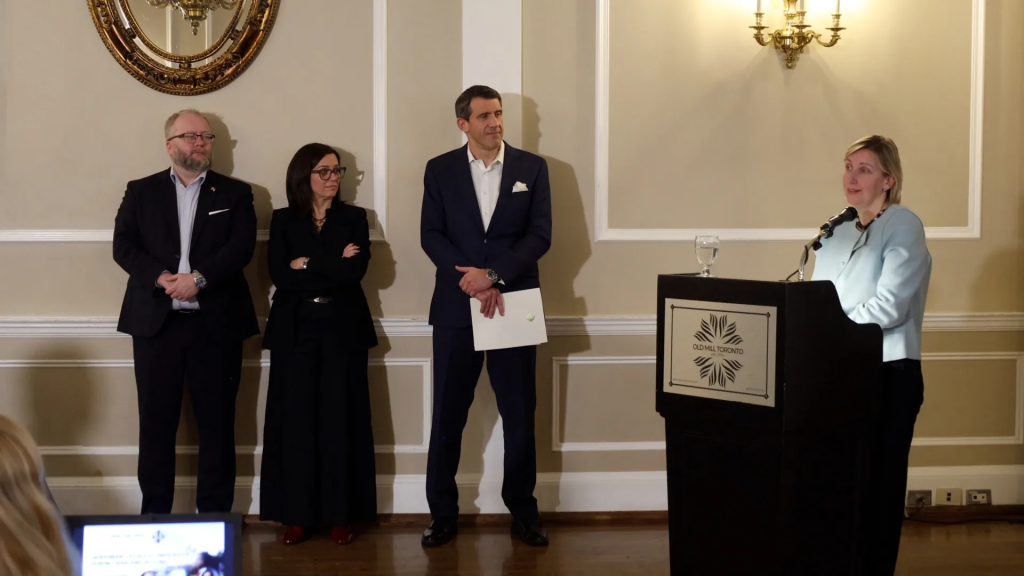
“We see young people demonstrating maturity and responsibility under extraordinarily difficult circumstances. The University’s task is not to lose this potential but to create an environment in which it can continue to grow”,
said the speaker.
To illustrate the scale of UCU’s work, she presented several key facts and trends:
Education and technological development:
- UCU became one of seven Ukrainian universities to join the defense technology cluster “BRAVE1”.
- The undergraduate program in robotics is among those developing solutions that can be used in the fields of security and defense.
Growth of online learning:
- As of today, UCU Online enrolls more than 25,000 students annually.
- By 2028, the University plans to increase this number to 100,000, and the number of participants in offline certificate programs – from 2,500 to 10,000 per year.
UCU’s medical and rehabilitation programs:
- The master’s program in physical and occupational therapy is the first in Ukraine, created according to international standards.
- 97% of its graduates work in state and private medical institutions in Ukraine and abroad.
- Between 2022 and 2024 alone, the University trained over 1,090 medical professionals working with wounded soldiers.
- The newly established UCU Medical Clinic provided 1,067 services to veterans and their family members as of July 2025.
Legal support for society:
- The UCU Legal Clinic provided over 480 consultations within a year to military personnel, veterans, families of missing persons, and internally displaced individuals.
“As an educational institution, we cannot influence the pace of events. But we can influence the quality of preparation of the people who will take part in them. That is our responsibility”,
summed up Sophia Opatska.
On the Contemporary Mission of the Center for Leadership of UCU
The portrait of the Ukrainian Catholic University would not be complete for the participants of the meeting without mentioning another important component – the work of the Center for Leadership of UCU. Andrew Rozhdestvensky presented the work of our team through the lens of cooperation with students, business leaders, public servants, educators, and the military. His presentation focused on how a culture of Leadership is formed in conditions for which no theory can fully prepare.
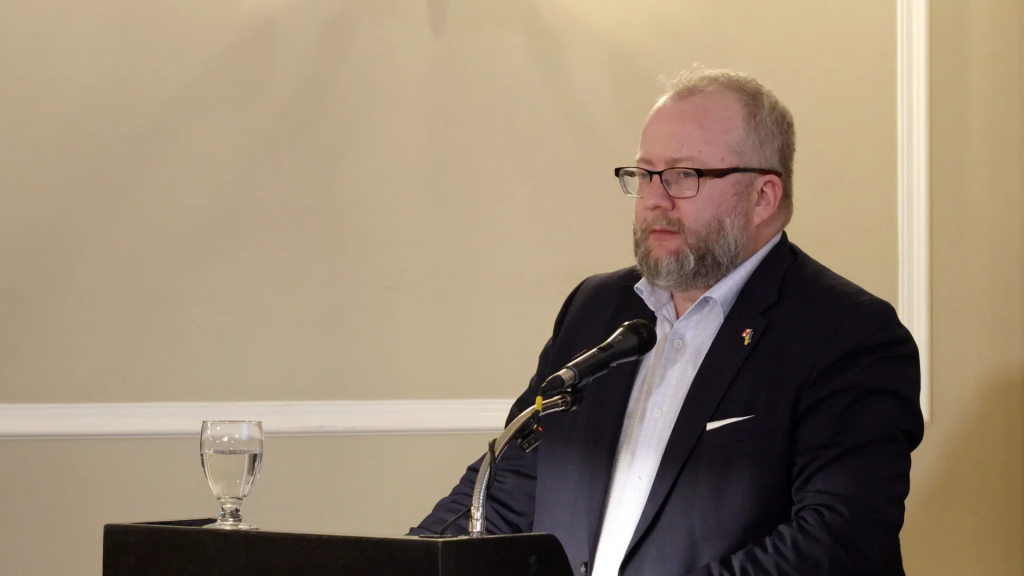
“The war has very clearly demonstrated that Leadership is not a synonym for rank or position. It manifests in the way a person makes decisions and works with a team. And also – in how one treats others. These are skills that can and must be developed”,
emphasized our colleague.
So what exactly does the Center for Leadership of UCU do today?
- It works with University students, developing skills of teamwork, responsibility, and reflection.
- It conducts programs for businesses and studies cases of companies that operate in critical conditions (such as shelling, labor market disruptions, or power outages).
- It cooperates with military units, where Leadership at every level is directly tied to effectiveness and the preservation of life.
- Based on this experience, it shapes shared reference points for the business community, military personnel, the civic sector, and the field of public administration.
“When we work with the military, we see a very high level of readiness to learn and to pass knowledge on to others. It is an environment where Leadership manifests itself daily, and where it simply cannot be formal”,
shared Andrew Rozhdestvensky.
This part of the presentation proved particularly meaningful for the business audience. It showed how, in military units, decision-making speed, coordination, adaptability, and other skills typically associated with Leadership in the corporate environment are practiced every single day. The only difference is that there, the cost of each decision – or its absence – is incomparably higher.
A kind of concluding note for both presentations came from UCEF Secretary Fr. Taras Dusanowskyj, who shared news about the official recognition of UCU by the Canada Revenue Agency as a foreign university that meets Canadian educational standards. This opens up new opportunities for strengthening partnerships, attracting resources, and expanding cooperation with the Ukrainian diaspora.
Instead of an epilogue: UCU as a “beacon of hope”
The meeting in Toronto presented the Ukrainian Catholic University as it is today: an institution that works systematically and consistently, even when external circumstances are more challenging than ever. The University continues to develop educational programs, support students, launch social services, and prepare professionals the country needs right now.
The Center for Leadership of UCU, in turn, demonstrated how the experience of business, the public sector, and the military can become a shared space for learning and development – where theoretical discussions about Leadership are replaced with practical work alongside people who make decisions every day in conditions of high uncertainty.
For many participants, the evening made it evident that supporting UCU is not about charity but about investing in the capacity of Ukrainian society. And in this sense, the connection between the University and its friends in Canada carries not only a humanitarian but also a strategic significance. So, the most compelling part, it seems, is still ahead.